
District rollout information, onboarding, and coordination now live in rollout.chart-ed.com.

National Brief

Why Students Can Read Data, But Struggle To Reason With It

A cross-system Chart-Ed brief using reviewed state examples to show the recurring reasoning ceiling that appears across distinct standards and assessment environments.

The Case

A structural ceiling, not a local anomaly

Across the current reviewed set of standards and assessment environments, students are consistently taught how to interpret visible patterns, support answers, and work with data representations. What is not systematically required is the next layer of disciplined inference.

Core Finding

Students can describe what data shows, but are not consistently taught how to evaluate what it means.

Recognizing limits of inference
Distinguishing correlation from causation
Qualifying conclusions using uncertainty

Figure

National Data Reasoning Ceiling Map

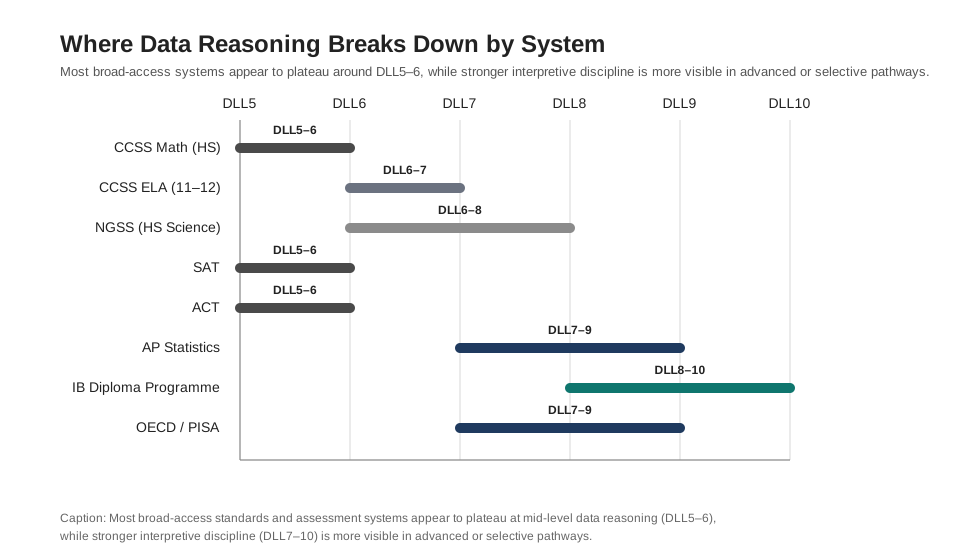
The chart below summarizes the current reviewed example set. Across these standards and assessment environments, the plateau remains concentrated around DLL5-DLL6.

Click image to enlarge

Grades 8-12

Why the ceiling still matters near graduation

The strongest internal crosswalk we have is not just that the ceiling appears in middle grades. It is that general-track expectations continue to cluster around DLL5-DLL6 even as students move toward graduation.

Grade Band
Ceiling
Interpretation
Grade 8
DLL6
Scatterplots and association appear, but boundary and causal limits are not routinely enforced.
Grades 9-10
DLL5-DLL6
Content complexity rises, but general-track reasoning demands still cluster around supported interpretation.
Grades 11-12 (general track)
DLL6-DLL7
Students support claims with evidence, but are not systematically required to justify limits of conclusions.
Grades 11-12 (advanced pathways)
DLL7-DLL9
Stronger interpretive discipline appears more clearly in advanced or selective pathways, not as a universal expectation.

Comparative Evidence

Broader system comparison

The same pattern appears when the comparison expands beyond states into broader standards and assessment environments. Broad-access systems tend to cluster around DLL5-DLL6, while stronger interpretive discipline appears more clearly in advanced or selective pathways.

Click image to enlarge

System
Range
What It Suggests
CCSS Math (HS)
DLL5-DLL6
Relationship interpretation without causal restraint or boundary language
SAT / ACT
DLL5-DLL6
Supported interpretation is assessed without explicit uncertainty or epistemic constraints
NGSS (HS intent)
DLL6-DLL8
Causal reasoning is encouraged, but not scaffolded through a routine uncertainty ladder
AP / IB / OECD-style pathways
DLL7-DLL10
Higher-order reasoning is visible, but concentrated in selective or advanced settings

Method Note

What makes this report defensible

Comparative synthesis

This brief is based on representative standards and assessment examples, not a full coded census of every state or framework.

Traceable internal anchors

The report is grounded in state-profile notes, DLL ceiling comparisons, and the internal grade-to-DLL growth map that informs reporting interpretation.

Non-ranking posture

The goal is to identify a recurring developmental pattern across system types, not to score, embarrass, or diminish any individual state.

Student Meaning

What this looks like in student reasoning

Typical Response

“The graph shows that as X increases, Y increases. This means X causes Y.”

Disciplined Response

“The data shows a relationship, but it does not establish causation. Other factors may explain the pattern.”

What Chart-Ed Adds

An extension layer, not a replacement

A clearer read on where student reasoning plateaus
A developmental model that extends DLL6 into DLL7-DLL9
Pilot-ready reporting and measurement without curriculum replacement

The opportunity is to extend existing systems into disciplined data reasoning, not to replace the strengths those systems already have.

Request A Follow-Up

Turn the report into a district conversation

If the report resonates, use this form to request a follow-up conversation focused on what the cross-state pattern may mean for your district, your state context, and a realistic pilot pathway.

National report walkthrough
State-context interpretation for your district
Pilot planning without curriculum replacement
Download PDF Again